
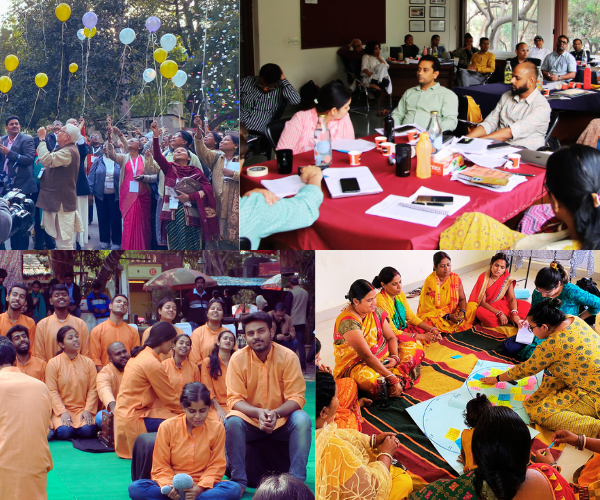
Participatory Research and Knowledge Democracy: Established in 1982, Participatory Research in Asia (PRIA) has pioneered participatory research and knowledge democracy, demonstrating that sustainable change is achieved when citizens are recognised as knowledge holders, active participants, and co-creators. Through its philosophy of Knowledge, Voice, Democracy, PRIA has influenced community-based research, policy, and practice in democratic governance, sustainable development, adult learning, and social inclusion.
Participatory Learning and Capacity Building: PRIA has developed and refined participatory learning methodologies that strengthen individuals, organisations, and institutions. Its approach integrates participatory and experiential learning, institutional development, and leadership development to enable citizens, social purpose organisations, local governments, higher education institutions, and development professionals to analyse contexts, generate locally relevant solutions, and drive institutional transformation.
Participatory Governance – Panchayats and Municipalities: PRIA is a leading Indian organisation in promoting democratic decentralisation and participatory local governance. Its extensive engagement with Panchayati Raj Institutions and Municipalities has strengthened citizen participation and inclusive decision-making; participatory planning and social accountability; and institutional capacities for responsive local governance.
Multi-Stakeholder Partnerships: PRIA possesses extensive experience in facilitating partnerships among governments, communities, civil society, academia, philanthropy, and the private sector. As a trusted intermediary, it connects diverse stakeholders around shared learning and collective action, helping translate research into policy, policy into practice, and community experience into scalable solutions.
National and Global Social Capital Networks: Over four decades, PRIA has cultivated extensive networks across India, Asia, and globally, connecting practitioners, researchers, universities, governments, development agencies, and philanthropic institutions. These networks facilitate South-South and South-North learning, collaborative research, knowledge exchange, and collective action, thereby strengthening PRIA's capacity to foster innovation and influence policy and practice.
UNESCO Chair: Global Recognition and Higher Education: As holder of the UNESCO Chair in Community-Based Research and Social Responsibility in Higher Education, PRIA has established a global platform for advancing engaged scholarship, community-based research, and university-community partnerships. Through international collaborations and networks, the Chair contributes to participatory knowledge creation and more socially responsive higher education, aligned with the Sustainable Development Goals (SDGs).
Educational and Training Infrastructure in New Delhi: PRIA's institutional infrastructure in New Delhi serves as a hub for learning, research, dialogue, and capacity development. Its facilities support training programmes, participatory research, policy dialogues, and multi-stakeholder consultations involving government, civil society, academia, development practitioners, and international partners, providing a platform for knowledge exchange, innovation, and collaborative action.
Global Transformations Reshaping Development: Globalisation, technological advancements, urbanisation, demographic shifts, climate crises, and geopolitical realignments are fundamentally transforming the relationships between states, markets, civil society, and citizens. The SDGs, the COVID-19 pandemic, ongoing conflicts, climate emergencies, and economic uncertainty have collectively underscored the imperative for development approaches that are resilient, inclusive, locally grounded, and participatory. With the global economic centre of gravity progressively shifting towards Asia, the region is increasingly serving as a crucible for novel development ideas, institutions, and partnerships.
Asia's Emerging Development Landscape: Asia presents a complex tapestry of ageing societies, youthful populations, rapidly expanding economies, and some of the world's fastest-growing cities. While this growth has demonstrably reduced poverty, persistent challenges remain in areas such as inequality, environmental degradation, social exclusion, and democratic governance. Governments are actively investing in digital transformation, infrastructure development, and competitiveness, while citizens are concurrently demanding greater participation, transparency, and accountability. Climate change, migration, public health, and technological disruption increasingly necessitate cross-border and multi-stakeholder responses. India, as the world's most populous nation, a significant democracy, and a rapidly growing economy, embodies these regional transformations while simultaneously offering unique insights into Asia's evolving political economy of development.
The Changing Political Economy of Civil Society: Civil society across Asia is becoming increasingly diverse, with traditional non-governmental organisations (NGOs) operating alongside social enterprises, technology platforms, impact ventures, corporate foundations, and hybrid organisations. While these diverse actors introduce innovation and new avenues for financing, a growing emphasis on scalability, measurable outcomes, and technology risks marginalising crucial considerations such as participation, social justice, power dynamics, and institutional change.
Development finance is undergoing a parallel transformation as the significance of traditional international assistance diminishes. Domestic philanthropy, Corporate Social Responsibility (CSR), impact investing, blended finance, and Environmental, Social, and Governance (ESG) investments are all expanding. India's mandatory CSR framework, in particular, has generated substantial new resources for social development. Nevertheless, Indian civil society organisations face significant challenges, including limited access to unrestricted funding, escalating compliance requirements, leadership transitions, digital pressures, and demands for measurable results, which are particularly arduous for smaller grassroots organisations.
Governance, Civil Society, and Democratic Space: Governments are increasingly reliant on civil society for the provision of public services, disaster response, health, education, and livelihood support, even as civic space has become more contested in various parts of Asia. Digital technologies present new opportunities for participation but also introduce challenges related to misinformation, polarisation, and surveillance. India's constitutional commitment to democracy and decentralisation provides a vital foundation, yet uneven devolution, fiscal centralisation, institutional capacity gaps, and regulatory pressures constrain local democratic processes. Strengthening participation necessitates investment in responsive institutions, robust citizen engagement mechanisms, and collaborative knowledge systems.
Urbanisation, Climate Change, and Community Resilience: Rapid urbanisation and climate change are intensifying the impacts of heat, flooding, water scarcity, pollution, biodiversity loss, and livelihood risks. Achieving resilience demands more than mere technological solutions; it critically depends on effective local governance, robust community agency, the integration of Indigenous and local knowledge, and strategic cross-sector partnerships. India's extensive experience with community-based resource management, disaster preparedness, and local adaptation offers valuable regional learning.
Youth, Knowledge, and the Future of Development: Asia's contrasting demographics create both opportunities and challenges. India's substantial youth population offers considerable potential for innovation and economic growth, but concerns regarding skills development, employability, inequality, and civic participation remain critical. Universities and knowledge institutions can play a transformative role through community-engaged research, participatory knowledge production, lifelong learning initiatives, and fostering local innovation. Stronger partnerships among communities, governments, universities, and social purpose organisations will be indispensable for generating locally relevant solutions and facilitating cross-regional learning within Asia.
PRIA@50 necessitates a precise articulation of PRIA's enduring principles and essential evolutionary pathways. Its distinct advantage lies in its capacity to integrate participatory research and learning, knowledge democracy, capacity development, institutional strengthening, and multi-stakeholder action. The strategic imperative is to leverage these capabilities to cultivate influence, thereby enabling community-generated evidence to inform practice, shape policy, mobilise resources, and facilitate adaptation and scaling.
Define and Communicate PRIA's Distinctive Institutional Proposition: Clearly delineate PRIA's enduring capabilities—encompassing participatory research and learning, organisational and leadership development, planning, monitoring, evaluation, and learning (PMEL), knowledge exchange, convening, and partnership-building—from its evolving thematic priorities. Position PRIA’s strategic pathways (discussed in the next section) as critical domains where these capabilities address emergent challenges, supported by an institutional Theory of Change that articulates their shared outcomes and interconnections.
Integrate Policy Influence and Scaling Across All Strategic Pathways: Embed policy influence and scaling as intrinsic elements of programme design, rather than treating them as subsequent communication activities. For each pathway, identify priority institutions and decision-makers, relevant policy and financing windows, strategic coalitions, and mechanisms through which community-generated evidence can progress towards institutional adoption, policy influence, and replication.
Establish a Distinctive Platform on Climate Resilience and Adaptation: Consolidate PRIA's work around community-led adaptation, urban water resilience, Indigenous and local knowledge systems, participatory governance, and locally owned solutions. Utilise the nexus of urbanisation, climate, youth, and the green transition to connect PRIA's urban and youth portfolios, thereby establishing a coherent body of knowledge and practice.
Position Youth and Higher Education as Active Partners in Knowledge and Social Change: Shift the perception of youth beyond that of primary beneficiaries by actively engaging them as researchers, knowledge producers, civic actors, and partners in climate action and democratic governance. Deepen collaborations with higher education institutions on community-engaged research, practice-based learning, and knowledge exchange, leveraging PRIA's UNESCO Chair and global networks.
Develop the PRIA International Academy as a Strategic Institutional Pillar: Leverage the PRIA International Academy (PIA) to translate PRIA's knowledge and experience into structured learning programmes (face-to-face, online, hybrid), research initiatives, advisory services, and knowledge exchange platforms. Cultivate partnerships with universities, research centres, CSR entities, and philanthropic organisations, including opportunities for experiential internships. Over time, explore PIA's potential evolution towards a university or 'deemed university' model, incorporating Centres of Excellence.
Diversify Resources and Build Institutional Capacity for Scale and Resilience: Make deliberate strategic choices regarding geography, scale, and institutional priorities based on PRIA's comparative advantage. Pursue scaling through replication, institutionalisation, policy adoption, financing, and network diffusion, while diversifying resource streams across donors, philanthropy, CSR, government, High-Net-Worth Individuals (HNIs), and fee-based models. Strengthen technology and innovation as cross-cutting organisational capabilities.
Selectively Expand into Emerging Areas Through Participatory Research: Utilise PRIA's participatory research capabilities to enter new domains where it can generate distinctive value—including active ageing, climate-responsive adolescent health, digital and financial inclusion, gender-responsive urban mobility, women's digital trust, and aspirations of urban low-income communities. Prioritise opportunities that offer credible pathways to learning, partnership, policy influence, and/or scale.
Strategic Architecture: The strategy should be constructed around enduring institutional capabilities as its foundational bedrock, strategic pathways as arenas for application and innovation, and policy influence, scaling, partnerships, gender and social inclusion, and technology/innovation as overarching, cross-cutting priorities.
PRIA@50 should strategically position PRIA as a participatory knowledge institution and trusted intermediary, effectively connecting communities, institutions, evidence, policy, and resources—thereby facilitating collaborative knowledge generation, learning from action, influencing decisions, and fostering sustainable and scalable solutions.
The Strategic Pathways
The foregoing analysis suggests PRIA adopt the following Strategic Pathways:
Democratic Governance and Citizen Participation: This pathway aims to strengthen participatory, inclusive, and accountable governance by empowering citizens—particularly women, youth, and marginalised groups—to engage meaningfully in local decision-making, planning, and accountability processes. It builds upon PRIA's extensive experience collaborating with Panchayats, Municipalities, civil society organisations, and citizens.
Climate Resilience, Sustainable Livelihoods, and Ecological Security: This pathway supports communities and institutions in addressing climate and ecological challenges through locally relevant adaptation strategies, resilient livelihoods, water security initiatives, sustainable natural-resource management, and the integration of Indigenous and local knowledge. It establishes a clear connection between climate resilience and economic, ecological, and social security.
Knowledge Democracy, Learning, and Institutional Transformation: This pathway focuses on advancing participatory research, fostering knowledge creation, implementing robust Planning, Monitoring, Evaluation, and Learning (PMEL) frameworks, facilitating organisational development, and strengthening institutional capacities. The objective is to enable communities and institutions to generate, utilise, and disseminate knowledge effectively for social change. This pathway positions PRIA's core philosophy of 'Knowledge, Voice, Democracy' at the heart of its institutional contributions.
Youth, Higher Education, and Social Innovation: This pathway seeks to empower young people and higher education institutions to become proactive partners in knowledge creation, civic engagement, climate action, and social innovation. Leveraging the UNESCO Chair, PRIA International Academy, and global networks, this pathway facilitates the integration of community knowledge with research, education, and the development of emerging generations of change-makers.
PRIA@50 positions PRIA’s strategic pathways as focused arenas of change, while making explicit the institutional capabilities and influence mechanisms that connect them. The logic below integrates evidence-to-policy influence and scaling as core pathways.
Vision / Long-Term Impact
By 2032, PRIA contributes to an ecosystem in India and Asia in which communities, institutions and knowledge networks collaborate to advance participatory democracy, accountable governance, climate resilience, inclusive development and sustainable solutions—using knowledge generated with communities to influence decisions, strengthen institutions and enable wider adoption.
Enduring Institutional Capabilities
Overarching Theory of Change
IF PRIA applies its participatory research, learning, MEL, convening and knowledge-translation capabilities through focused strategic pathways; AND IF communities, institutions, researchers, policy actors and resource partners are connected around credible evidence and shared learning; AND IF PRIA deliberately builds pathways from local evidence to policy influence, institutional adoption, financing and replication/scale; THEN locally grounded innovations and knowledge can influence practice and policy, strengthen institutions, and spread beyond individual projects; SO THAT communities and institutions are better able to address complex social, governance and climate challenges in inclusive, accountable and sustainable ways.
Cross-Cutting Influence and Scale Pathway
Programme Pathway 1: Urban Water Resilience and Stewardship: Community-Led Climate Action and Water Net-Zero Pathways
Recent / demonstrated entry points: Demonstration of urban water-body restoration in Ajmer and Jodhpur, Rajasthan; participatory WASH and social accountability; community-led service-level benchmarks; and city-wide, informal-settlement-focused, data-driven sanitation engagement.
Programme Pathway 2: Bridging Knowledge and Local Governance: Tribal Youth for Climate Resilience
Recent / demonstrated entry points: Supporting tribal citizens’ leadership in local governance; participatory planning in PESA zones; promoting community/Indigenous knowledge through UNESCO Open Science; DECODE global learning; youth researcher-led Asian climate action; and policy/training support for NEP/UGC mandates on community-engaged teaching and research.
Programme Pathway 3: Expanding Global Outreach through PRIA International Academy
Recent / demonstrated entry points: Build PIA as a strategic institutional platform; expand Master Classes and courses; deepen evaluation and impact assessment; document adaptive management and youth-led accountability/advocacy; and mentor HEIs globally.
Programme Pathway 4: Leveraging Participatory Research for New Sectoral/Thematic Partnerships
Recent / demonstrated entry points: Elderly Reminiscence and Active Citizenship (in partnership with Singapore University of Social Science – SUSS); climate-responsive public health planning for adolescents; and digital and financial inclusion of women and the marginalised.
System-Level Outcomes By 2032
Key Assumptions
Strategic Learning and Adaptation
The institutional MEL system should track not only activities and outputs, but the movement of evidence through the change pathway: changes in community capability and agency; institutional adoption; policy engagement and influence; financing; replication and scale; and unintended effects. Periodic strategic reviews should test the assumptions behind each strategic as well as programme pathway and inform choices about where PRIA should deepen, adapt, partner or exit.